Showing posts with label victoria. Show all posts

Wednesday, November 20, 2013

Spoonbill enjoys the support of hunters

We live in an interesting state! At at time when the governments of several Australian states have banned recreational waterfowl hunting the current Victorian government is actively promoting the activity.

We live in a democracy and I believe there are some 42,000 recreational shooters in Victoria. Game hunting of waterfowl and Stubble quail is an activity that goes back generations in many regional communities. Member organisations such as Field and Game Australia (FGA) have a considerable voice. Interestingly one founding focus of the FGA was the conservation of dwindling and damaged wetlands (with the consequent loss of game to shoot). The FGA continues this work and I am often confronted by this irony when enjoying my own recreational pursuit.

Royal spoonbill, Phillip Island
This happened again when I turned from photographing this spoonbill to take a scene shot. I find that the wetland is owned / sponsored by the local branch of the FGA. There are many such examples across the state.

Is this the longest wetland name ever?
An example of how entrenched the hunting culture is in this state is that many of Victoria's best known bushland reserves are classified as State Game Reserves, many of which are available for shooters to hunt (within prescribed seasons).

The current government has set up a new authority called Game Victoria to supervise the duck season. This used to be done by the Department of Sustainability and Environnment. It is my understanding that the new body is filled with affiliates of FGA and the Sporting Shooters Association as outlined in this Melissa Fyfe article in The Age.

Generally speaking the trends are towards facilitating the licensing of shooters (with more flexible licence packages etc) and the "development of improved hunting opportunities" as expounded in the Government's media release Creation of Game Victoria signals new era.

Tucking in! Royal spoonbill
Black swan and cygnet also enjoying the wetland
While I do not understand the attraction of shooting birds as recreation I am not against the concept of sustainable hunting that puts a meal on the plate. I have no problems with anything that is proven to support regional communities.

The final link is to Birdlife Australia's position statement which has changed in recent years and concludes:

Position Statement

BirdLife Australia considers that recreational waterfowl hunting should not be allowed in Australia and its Territories.

This Policy supersedes RAOU Policy on Waterfowl Hunting (2) adopted by Council on 29 May 1994. The scope of this policy is limited to the hunting of waterfowl for recreational purposes, and not where hunting is for traditional food or ceremonial functions, or to mitigate the effects of agricultural or environmental damage.

Reasons for the change of Policy

  • We believe society in general, and our Members in particular, consider the killing of native birds for recreational purposes is an inappropriate interaction between people and their natural environment,
  • It has a potentially negative impact on bird conservation through: killing of non-game species, damage to wetland habitat, and disturbance of birds; these impacts are not likely to be adequately off-set by shooting industry-funded habitat protection and restoration programs, 
  • While BirdLife Australia is not primarily concerned with animal welfare issues, we cannot support an activity that on the balance of probability causes pain and suffering to animals, for no purpose other than recreation.
  • The pro-waterfowl hunting lobby has not shown sufficient commitment to ensuring or demonstrating sustainability of the resource.
Bird on!

Sharing with Wild Bird Wednesday

Monday, November 28, 2011

Big fans of the beach!

One day I will take a decent photo of a fantail. Today is not that day but did enjoy good views of Grey fantail right down on the beach walking east from Silverleaves, Phillip Island today.


Also seen were Hooded plover, Red-capped plover (recently nesting AT Silverleaves beach), Crested tern, Masked lapwing and Superb fairy-wren to name a few. As well as ibis and great cormorants flying over there wes also two sightings of Royal spoonbill.

The purpose of the walk was to visit the site when the Grand-parents came across Pied oystercatcher hatchlings (nearly stepped on them apparently) last weekend (20 November). Here's Harry's picture.

Pied oystercatcher hatchling
Photo H. Farthing

Today at low tide, approaching from a distance I did see a ball of fluff running for cover through the binoculars (just the one). I was then taken aback by the sight of a Pied osytercatcher actually walking towards me!


Hmmm, am I getting warmer?

A couple of flight displays (swoops) told me I wasn't really wanted and I moved on.

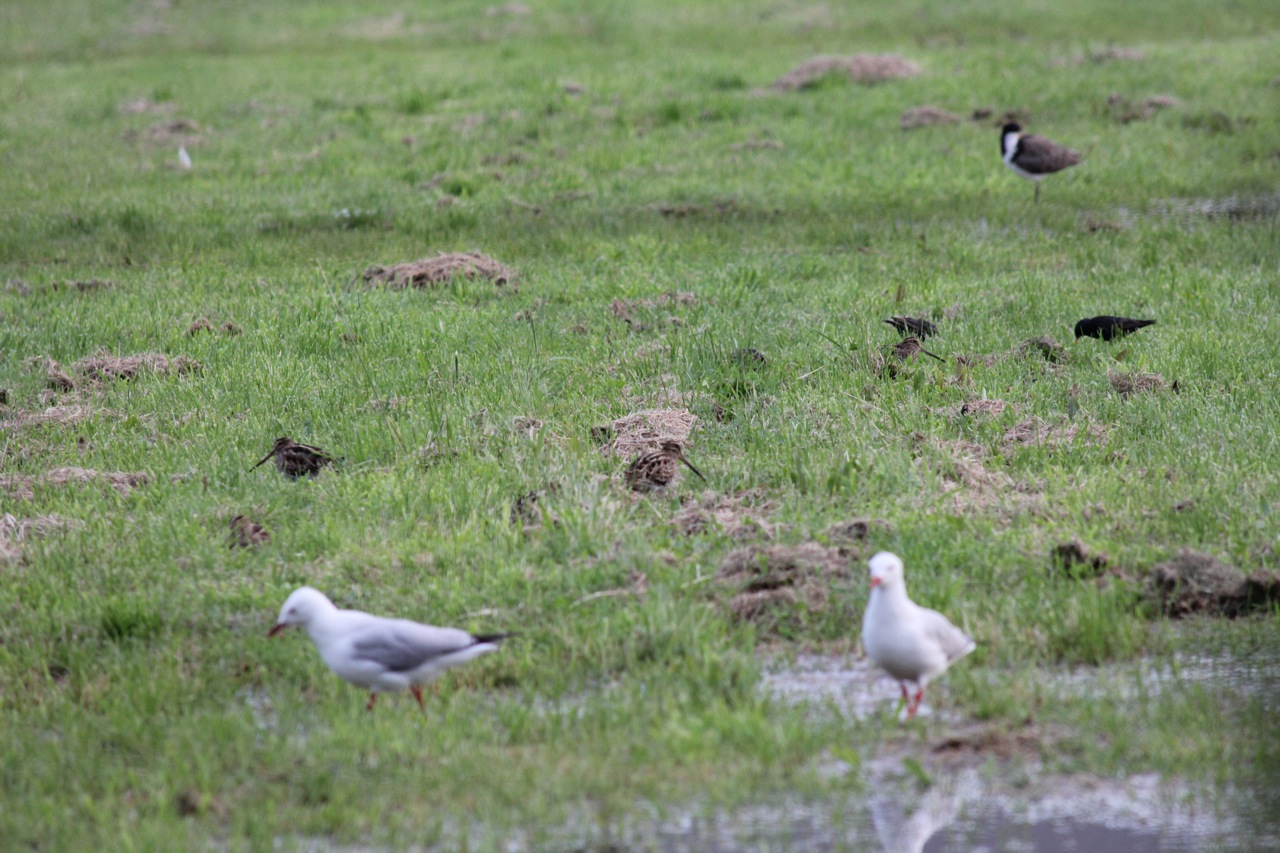
Later in the day we also enjoyed views of a flock of Yellow-tailed blacks (12) moving through the banksia and Latham's snipe (9) enjoying a temporary wetland as we started the drive back to Melbourne. These photos taken from the car in Honeysuckle Grove, Silverleaves:

Snipe @ Silverleaves
Around 6 birds in this view alone

Latham's snipe, 7.40PM EDST

Seeing snipe here was very much a chance sighting and will probably result in continued slow-driving past wetlands behaviour for many years to come!

Wednesday, November 23, 2011

Common bronzewing calling

To me a little sense of mystery surrounds my sightings of Common bronzewing.
It was a few years of birdwatching before I even identified one. I must have seen or heard them before my birding existence - I was in their domain after all. It is probable that unless you're some sort of "birder" seeing a bronzewing does not even register in one's consciousness.


Common bronzewing (male)
at Hochkins Reserve, North Croydon
Mysterious because having not been aware of them before, they then "appear" in the parks of suburbs in which I live and work.
I identified the bird a few times before I ever heard them call. Then one day I heard it - the booming but soft and deep resonating repeated "oom". I couldn't see the bird, I didn't even know it was a bird. I remember a woman passed. I explained and queried. She heard also and declared "Owl!" (I wish). Eventually I worked it out.


Common bronzewing - the female colouring
Blackburn Lake
Mysterious because on the one hand they are elusive and yet not. In a place I regularly pass I will make a single unexpected sighting and then not again for many, many months. Yet their call can be readily heard over 100m away and once heard they can usually be tracked down - what a give away! Also they are just as likely to frequent the picnic spots of forested areas, wandering calmly through the car park - they even visit the bird feeder in my father-in-law's suburban deck!

I remember enjoying watching this bird at the car park at Badger Creek Weir and was able to record some video of it calling (perhaps would have been better if the camera wasn't set to a fixed focal point just beyond the bird).


Having also seen a male bird display from a distance I know I would also enjoy a closer view of that fanned tail .... and perhaps a few shots.


Anyway .... now for the Brush & Flock bronzewing varieties!!

Monday, November 21, 2011

Cracking pardalote views

Enjoyed cracking views of this female (or immature) Spotted pardalote at Blackburn Lake yesterday. Also recently arrived in town are a few Sacred kingfisher and Musk lorikeets. Amongst the regulars there are also a few cooperative Chestnut teal and some less cooperative Mistletoebird (hence no pictures).

Personally, Sacred kingfisher and Mistletoebird were not birds I'd seen at Blackie Lake until a few weeks ago. It is a pleasure to see them regularly at the moment (I gather it is hoped that the kingfishers may nest).


                                        Spotted pardalote                                          

                                    Sacred kingfisher                                    

When backlit by sunshine the colouring changes
(it happens to be a different bird, same day)

                                                       Musk lorikeet                                                      

                                                            Chestnut teal                                                         

                                                     The carp are huge!                                                     

Thursday, October 27, 2011

Terrific Terrick!

If you make a triangle out of the Victorian towns of Bendigo, Echuca & Kerang then the Terrick Terrick National Park sits in the middle. It contains an unfamiliar environment with native pines and grasslands with a few areas of rocky outcrops. Similarly the birding was unfamiliar & I'm sure that many more "ticks" could have eventuated if we had more local experience or a little homework under the belt.

The 45 minute drive down from our digs at Torrumbarry resulted in stops to view brown falcon, white-fronted chat, Australasian pipit, brolga (did I mention?) &  long-billed corella.


In the cool temperate rainforest & other bush surrounding Melbourne you can't leave a track, even if you wanted to, without a machete. It was strangely satisfying to walk in and amongst the actual bird habitat rather than view it from a track. Although I did do less of this after we saw several long reptiles.

Native pine and grasses

The Mitiamo cemetery section

Climbing Mt Terrick

The team!
The day was warm and we were there from about 10am until 3pm - not ideal for birding. Several sightings were lifers (of these a couple were suspected at the time but confirmed by photograph later on) but I feel we really dipped on a variety of honeyeaters that are often seen.

Black-faced cuckoo shrike -
the immature birds still get me thinking I might
have something new!

Rufous songlark (above & below)
AKA Noisius buggeris


Red-capped robin

Hooded robin

Mistletoebird (after a big night I think)
Southern whiteface (needs a wash)
Hannah was great company and started keeping her own list. She pays greater attention to bird counts than I can be bothered with at times!

Written while driving on gravel
Please excuse hand-writing!
To the north of the forested section of the Park are some areas of designated Park described as native grassland. We had a brief look at the grasslands (didn't get out of the car) where people try to see Plains wanderer (at night I think). We found them difficult to distinguish from the farmed paddocks - some of the locals indicate that they are farmed paddocks (or have been).

I am very grateful to Peter Allen & Keith Stockwell's birding guide for Terrick published via Echuca BOCA's website:

http://users.mcmedia.com.au/stocky/TerricksGuide(WP).pdf

And thanks to Tim Bawden for suggesting the place.


We were also hoping to see Diamond firetail but that's another story....

Wednesday, October 26, 2011

Silverleaves vermin out of control

In my absence Kath & the girls recently drove through Silverleaves & photographed species (pests?) now wandering freely through public grasslands.

Measures may need to be taken to control these species, hitherto almost absent in the area (apparently), but which are now reaching plague proportions:


The brolga is off my back!

Yes, finally I am able to state that I have seen brolgas and name the date, place & circumstance. Having never been quite sure that childhood memories of seeing these birds in SW Victorian paddocks were real or imagined I don't have to fret any longer.
The sighting was not a 30 minute utopia of photographing courting birds in a graceful dance. Rather it was a 30 second "Shit, they might be brolgas!", car screeching to a halt (from 100kmh), camera & binocular fumbling liaison that could easily have ended in disaster!

Anyway it was still special. The birds loomed large in my mind's eye as I was taking the pictures - so I am somewhat disappointed at the distant, grey, brolga-shaped silhouettes that resulted!:

Pizzey: "Flight distinctive: neck and legs extended,
wingbeats slow, majestic..."

I agree!

Disappearing over the flat plains of north-central Victoria
Hannah knew I was looking out for them ..... we "high-fived" and drove on to Terrick Terrick National Park (report to follow!).

Sunday, September 18, 2011

Badger Creek Lyrebirds

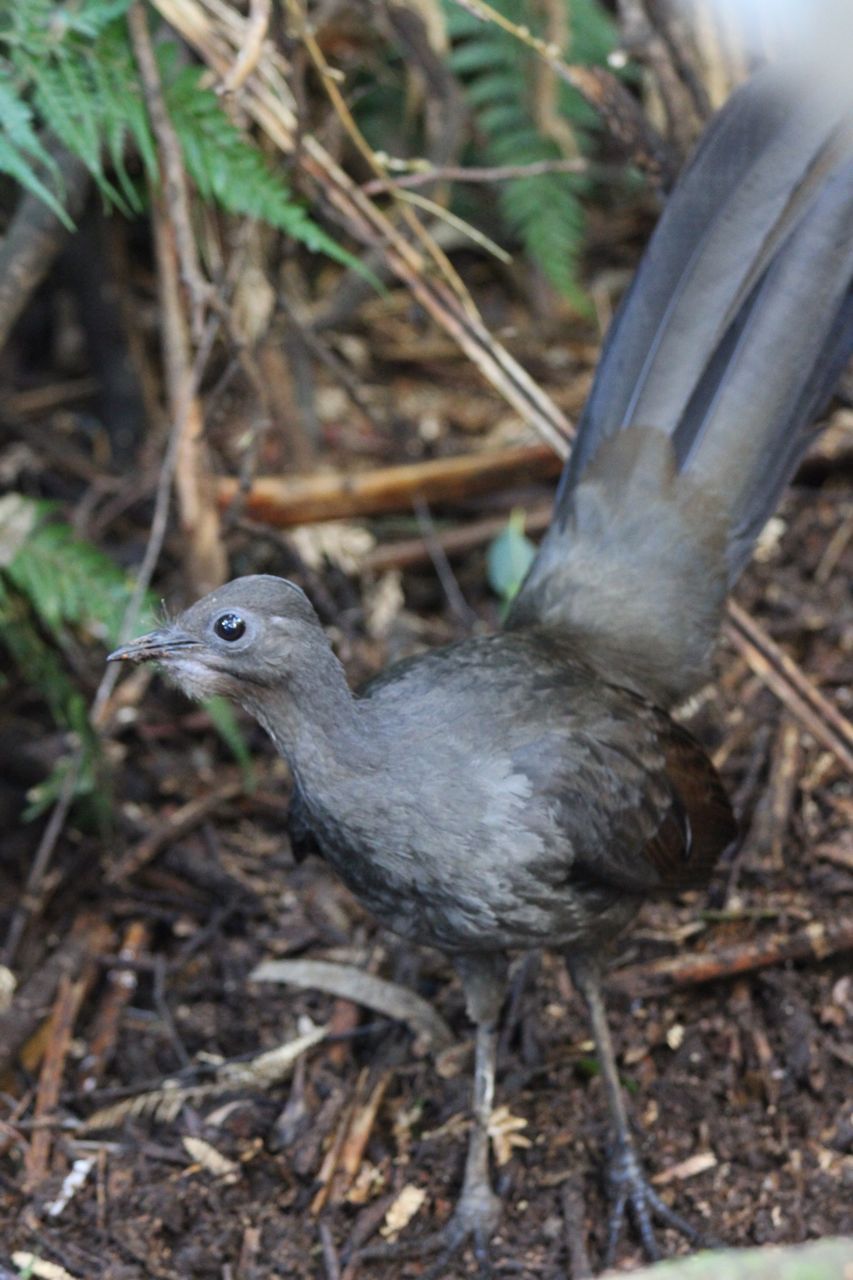
Enjoyed a very close encounter with this female lyrebird on the trail to Badger Creek weir (video below).

Two males we saw weren't as engaging but both demonstrated impressive mimicry close to hand that alerted us to their presence (a whistler "whip", a kookaburra's laugh).


For completeness sake I include a shot of a captive male Superb lyrebird taken at Healesville Sanctuary a few years ago:


Tuesday, September 6, 2011

Orioles back in Hochkins!

I remember first seeing an olive-backed oriole in Bundanoon NSW & had just imagined they were a North-of-the-Murray sort of bird until coming across one at Hockins Ridge Reserve in North Croydon last December. I remember suggesting to a fellow birder in January that we could pop in & see them again. Lucky we didn't because I have not seen them since. This prompted a dive into Pizzey to learn that they are of course, semi-migratory. We'll they're back! This view is of a bird at the top of the tree canopy - therefore is not a great image. They have a call which is actually sort of familiar & quite recognisable.


As a result of this momentous occasion, the Turnstones end of August tally has raced along to 172!

I reckon it's a suburban gem!
Common bronzewing and Grey butcherbird are resident locals

Monday, March 21, 2011

My Deen Maar specials

Well they may be easy fodder for the more serious & experienced birder but Deen Maar introduced me to some species I hadn't had much to do with.

Firstly I was introduced to the Southern Emu-wren. I didn't go there looking for them & had not seen them before nor read much about them.
So embarrassingly I...
  • didn't notice the emu feather tail until checking photos later on!
  • thought I must have two lifers, having seen the tincy dark brown female (was quite disappointed to realise they were the same bird - please correct me if I'm wrong!)


The second bird had me rifling through the hitherto largely untouched pages 164-197 of my 2001 Pizzey. Oh my God - I had ignored those pages for good reason! When I saw this bird (actually a pair) I thought "Great, easy tick!" Some 45 minutes of exploring various resources later I realised - not so easy! Comparing my photos with various descriptions and other images I have nervously (Pizzey "uncommon regular migrant to to s. Australia") but confidently concluded that this is a Wood sandpiper:


Finally I also enjoyed first decent photographs of what I believe to be Golden-headed cisticola and Striated fieldwren.


As I mentioned on the previous Deen Maar post, I believe I was the only person out there. This is just as well as anyone following me would have seen a lot of this:

Post-Wood sandpiper perfect take-off
Go on click on it, you know you want to!

And I see that the Buff Budgies are just making up bird names now - or at least seeing things I don't believe exist. Congratulations Richard on Red-browed pardalote. Is that bird 206 for the year?

Spell check doesn't like pardalote. Look it did it again.... pardalote, pardalote, pardalote.

Peter (RTs - now on 144 glorious Victorian birds)