Showing posts with label Wee Jasper. Show all posts

Sunday, January 20, 2013

White-browed woodswallow & other road trip birds

We drove home from Wee Jasper to Melbourne last Saturday. Here are the car stoppers! The first two shots were taken on the Wee Jasper - Yass Road near the intersection with Sawyers Gully Road (locale known as Narrangullen?).

White-browed woodswallow 
Australasian pipit
Nankeen night-heron lurking near the bridge over the Goodradigbee at Wee Jasper
Lunch was at Holbrook (the queue at the well-known bakery was out the door - we settled for our own sandwiches) where I was surprised to see Blue-faced honeyeater and a pair of Dollarbirds.


This Dollarbird and what I believe to be Yellow thornbill were seen when walking the Ian Geddes Bushwalk at Holbrook.

Nice January additions to this Melbourne birder's year list!

Bird on!

Saturday, January 19, 2013

White-bellied sea eagles, Goodradigbee River

In the recent heat wave conditions the increasingly shallow waters of the Goodradigbee River lost their usual mountain stream chill. With water temperatures as high as 28 degrees celsius we started to notice that every 100 metres or so one or two dead fish could be seen and this appears to have attracted scavengers. White-bellied sea eagle are a familiar sighting around the Burrinjuck Dam 8km downstream and are known to nest in the area. While doing a spot of trout fishing along the Goodradigbee River near Micalong Creek we were surprised to see a pair of sea eagles on the river and this in one of it's steeper gullies.

White-bellied sea eagle gaining height after being surprised by fisherman on the Goodradigbee River, NSW
We caught nothing by the way and blamed the warm water! Most of the dead fish were small (15-20cm) but this magnificent Brown Trout was found floating in the Micalong Creek! Tragic!


River scene where the sea eagles were seen. The river bank also shows the damage from last year's floods 
More images of the Goodradigbee River near Swinging Bridge Reserve (Jan 2012)
Platypus photographed from across the river at Swinging Bridge Reserve (Jan 2012, before the flood, not seen this year) 
Two images from the flood plain (and sometimes bed of the Burrinjuck Dam). Currently much water has been let out of the dam which was full in recent months

Bird on!

Friday, January 18, 2013

Bird construction Inc. (nests, tunnels, bowers)

It appears that summer in Wee Jasper is still family time with many juvenile birds around and still much evidence of nesting activity.

I am always a little excited to come up from Melbourne and see the Rainbow Bee-eaters. These are distant views taken across the Goodradigbee River but they show the bird leaving and approaching the nesting tunnel.

Rainbow bee-eater, January 2013

Fairy martin bottle nests
This Willie wagtail nest was built over the water. 
It was pointed out by the kids who had noticed it while floating down the river on tyre tubes. 
What works best - the feather or the cap? Not a nest of course but the bower of the Satin bowerbird.
And finally Marj K has some nice shots of Leaden flycatchers nesting at nearby Micalong Reserve.

Bird on!


Thursday, January 17, 2013

Wee Jasper birdsong

The air is full of birdsong at Swinging Bridge Reserve, Wee Jasper. "Song" is not always apt when much of the "noise" is coming from the large parrot population. Sulphur-crested cockatoo, King parrots, Crimson rosella and Galah were the most obvious during our visit last week. Yellow-tailed black cockatoo and Gang-gang (although not seen on this occasion) are also regular visitors.


Australian King parrot (male above, immature below)

Immature Crimson rosella
Rufous whistler were actively singing .... err ... whistling! A constant joy!
The penetrating piping of White-throated treecreeper added some further charm.
Yellow-faced honeyeater was the predominant honeyeater species and leant its frequent brisk call to the chorus. 

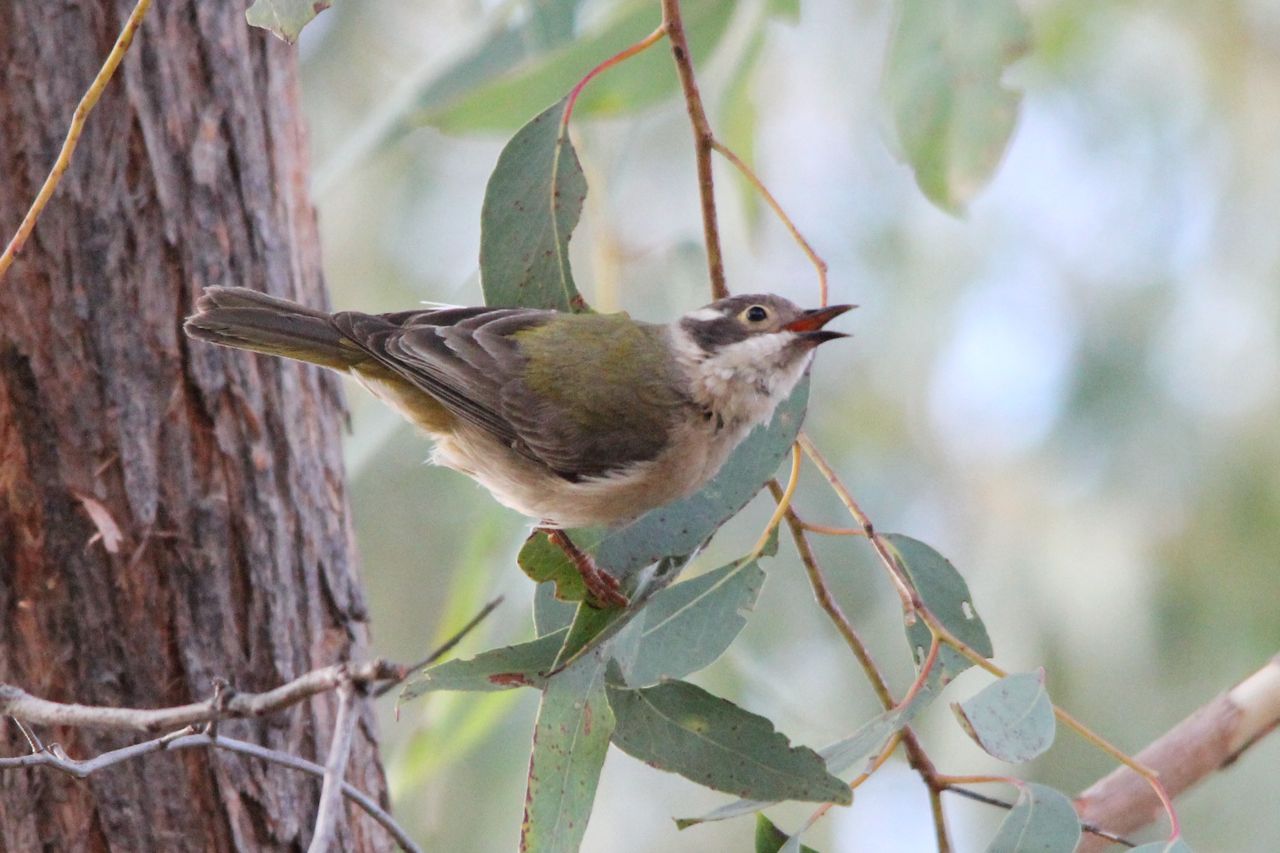
My first thought was that this was an immature Black-chinned honeyeater but it has been pointed out that Brown-headed honeyeater is a much better fit - Excellent - a lifer! A review of Pizzey suggests that there are five honeyeater species with that familiar white nape and paler front. Of these I am yet to see the Strong-billed honeyeater endemic to Tasmania.

The Leaden flycatcher buzzing calls added a different dimension as did the Satin bowerbirds at their bower. Noisy friarbird were ..... well, noisy! Kookaburras provided a daily (or twice daily) chorus. When I first heard roosting Australian wood ducks calling ("gnaaaaw") I wondered if I was listening to a broken kookaburra that couldn't get going!

Australian wood duck - We don't really "quack"

Large numbers of Superb fairywren led the small bird voice accompanied by White-browed scrubwren. Diamond firetail provided an occaisonal finchy flavour.


All in all a most pleasant and amazing soundscape!

Bird on!

Tuesday, January 15, 2013

Satin bowerbirds in active bower, Wee Jasper

This bower adjacent to our accommodation at Swinging Bridge Reserve, Wee Jasper, has been active for a few years now. We visited in January 2012 and again last week.

Satin bowerbird (Chlamydera violaceus) 
Fussing over a prized feather (I suspect a rosella tail feather) ....
and performing minor renovations.

I suspect this "green bird" is an immature male. The colouring differs slightly from the female bird after the third year with the satin blue-black adult plumage evident by seven years. This bird was noticed to be making several adjustments to the bower and its associated blue adornments. I'm not sure how the family politics runs when the younger males start making adjustments to the bower!

Satin bowerbird (immature male) 
Typical Wee Jasper scene

Bird on!

Monday, March 5, 2012

Wee Jasper floods

The little-known valley of the Goodradigbee River in NSW is close to the hearts of my entire family and many others besides. It has been with considerable concern and amazement that we have followed the news, pictures and video of the huge volume of water that is passing through Wee Jasper presently.

Readers of this blog can see that our family spent a wonderful week at the Farthing family cabin at Swinging Bridge Reserve, Wee Jasper in January this year. The birding images can be reviewed by clicking here.

My father-in-law happened to be staying at the cabin on the earliest day of major flooding and captured the torrent of water smashing the bridge (see the video footage here). Yesterday we believe the water was 60cm higher again.

Our thoughts are with all those living in the area.

More information and flood updates can be found on the Wee Jasper Reserves Facebook page. The first two pictures showing the flooded Swinging Bridge reserve are lifted from that facebook site.

Swinging Bridge Reserve, Wee Jasper, 4th March 2012
Picture from Wee Jasper Reserves Facebook Page

The conifers (centre right) can be seen in drier times below
(looking from the other direction). They provided camouflage
for a much-photographed Satin bowerbird bower
Picture from Wee Jasper Reserves Facebook Page


The Farthing family cabin at right
Swinging Bridge Reserve, Winter 2009

The northern entrance to the reserve - the roof of the cabin
just visible at the right appears in the first flood picture above!

January 2012
The "swinging bridge" can be seen at the rear. At it's
peak the water was higher than the bridge which
we believe has been destroyed.

Thursday, February 9, 2012

"Handedness" in birds

Left-handedness, left clawedness, left talonedness? The terms don't really roll off the tongue!

Now many birds only use their feet for mobility but I had heard that parrots were prone to being "left-handed".

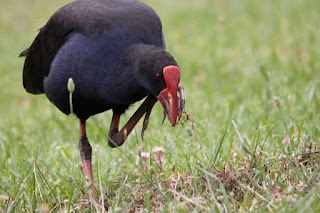
While watching this swamphen the other day at a reserve called Wurundjeri Walk in Blackburn South I started wondering about other bird groups:

Purple swamphen, Wurundjeri Walk
Porphyrio porphyrio melanotus 

Left foot

Left foot


Ahhh, right foot!
Ron Dudley's blog (Utah, USA) has amazing photos demonstrating his observed Handedness in Short-eared owls.

An old and small study of zoo birds described in this piece "Left handedness in parrots" concludes that to varying degrees parrots are at least 75% left-handed.

A BBC Earth News report details the findings of some Sydney researchers in Parrots preferred left-handedness and includes this observation:

"Young Sulphur-crested cockatoos all end up being left-footed, but when they first come out of the nest they are equally clumsy with both." 
Dr Culum Brown, Macquarie University, Australia

This study goes a little further and researched whether bird-handedness held clues for the development of human handedness.

It appears that some species of birds, parrots in particular do determine a left or right handedness. It just so happens that in many parrots left-handedness is more common than right handedness.

White-cheeked rosella, Platycerus eximius
Wurundjeri Walk, 9th Feb 2012

Crimson Rosella, Platycerus elegans
Wee Jasper, NSW, 5th July 2009
A left-footed Osprey, Pandion haliaetus?
Osprey handedness is also debated - No conclusions I'm afraid!
...or right-footed?
Both birds (or the same bird 30 minutes later) were
photographed at Caloundra, Qld, May 2011