Showing posts with label Double-banded plover. Show all posts

Friday, March 18, 2016

Killarney Beach Sanderling

Sanderling, Killarney Beach, SW Victoria, Australia
So I did catch up with some Sanderling at Killarney Beach last weekend. It took some persistence. For instance I watched a group of stint for some 45 minutes before concluding "Nope that's not what I'm after!" In their non-breeding colours they are had to tell apart if not seen adjacent.

Casting the binoculars to the far eastern sweep of the little bay I spotted a group of small shorebirds on a sandy section of the beach. Closer inspection required!

Yes, they have a cleaner, whiter appearance and are not as tiny - but the difference in behaviour from the Red-necked stint was clear. The Sanderling were moving in and out along the wet sand following the receding waves back, running away when the water comes in again, like someone in runners surprised by a wave.

I enjoyed observing and photographing. They were reasonably obliging. It was possible to pick a point that they were heading towards and wait ....


A single Double-banded plover had arrived from New Zealand
A young-looking Red-capped plover was also hanging around
The Sanderling were found close to the boat-ramp carpark at the eastern end of the Killarney Beach lagoon
I was so keen on checking my stint vs sanderling ID that I used the video setting on my camera to record some behaviour. Unfortunately it's not real steady as it is perched only on a monopod!


Bird on!


Wednesday, September 9, 2015

Watching for Shorebirds' Return, Phillip Island

We have had a cold and pretty wet winter in southern Victoria and it certainly doesn't feel like Spring yet. However I did manage to enjoy a beach walk to see Phillip Island's Rhyll Inlet at the weekend. This was in the late afternoon light during an hour or two of sunny and still conditions. I made my way to Observation Point and made these .... well .... observations!

In the breeding season, a pair of Pied oystercatchers generally hang around east of Silverleaves. I tried hard to get some  background in this shot. It shows French Island on the other side of a very calm Westernport Bay. The hills behind Grantville form the distant horizon.
Clicking for the enlarged view reveals Pied oystercatcher Red Flag 5E
Two endangered Hooded plover have paired off once again at the eastern end of Silverleaves beach. Meet current local "Orange Flag PW above Silver band"
Among the fascinations for me is the anticipation of what shorebirds will be present at the sandy spit that is Observation Point. Here are a few Curlew sandpiper among the Red-necked stint. In the foreground is an out of focus Red-capped plover 
Red-necked stint
A Double-banded plover in full bleeding plumage always stands out in the crowd! "Shouldn't you be in New Zealand?"
I am always on the lookout for Godwits, Whimbrel and Eastern curlew. Three Eastern curlew arrived while I was watching but I saw no Godwits which I found unusual. There was more than the usual number of ducks and I had some difficulty sorting the species as they kept their distance. I was impressed with the number of Australian shoveler, a species I generally don't see a lot of.

Eastern curlew, the hills between San Remo and Anderson in the background.

Several Australasian shoveler amongst the Grey and Chestnut teal. It might be worth a click for the enlarged view as the male shovelers have an amazing colour scheme. 
Great cormorant are generally outnumbered by Pied cormorant at Observation Point
This Australian pelican flew low across the surface of the water for at least 100m! I love watching that. It seems to be heading towards San Remo where the pelicans get fed each morning
My happy shadow - Observation Point at high tide (iPhone panorama). Westernport Bay to the left, Rhyll Inlet to the right
The return trek - I'm about to get wet and painfully cold feet!!
All worth it!
Bird on!
Sunday, August 10, 2014

DBPs with colour, Phillip Island

Double-banded plover Charadrius bicinctus, Phillip Island, 9 Aug 2014
I was interested to see photos of Double-banded plovers taken recently in Werribee, Victoria. The photos showed breeding plumage so I was inspired to pay a visit to Observation Point yesterday as I knew that these birds had frequented the sandy spit in our autumn earlier this year.

I have never seen them in colour before until yesterday. What handsome little birds!


They have intrigued me as they have a unique migration pattern - breeding in New Zealand and wintering in Australia. Pizzey states that part of the South Island (NZ) population migrates annually and spends February - September in Southern Australia.


I think we have a male (left) and female (right) in this shot. Rather than black, the female is said to have a brown upper band and less black and white markings on the forehead.
Female DBP feeding
While enjoying these birds' breeding colours for the first time there was an unexpected visitor ...


I have not seen a Ruddy turnstone at Observation Point before. It wandered around and fed in characteristic fashion.


Something about the angle of shot and posture of the turnstone implies that the two species are a similar size although the turnstone is generally slightly larger than the DBP
Ruddy turnstone vigorously flicking seaweed and other debris out of the way in characteristic fashion 
RT: "Yeah, I couldn't be fagged flying all the way to Siberia this year. "
DBP: "Choice Bro"
Another migrant dropped in for a real meeting of ways. Now we have (L-R) DBP, Red-necked stint and Ruddy turnstone
Red-necked stint
Caspian tern
Caspian terns, Observation Point, Phillip Island, Vic
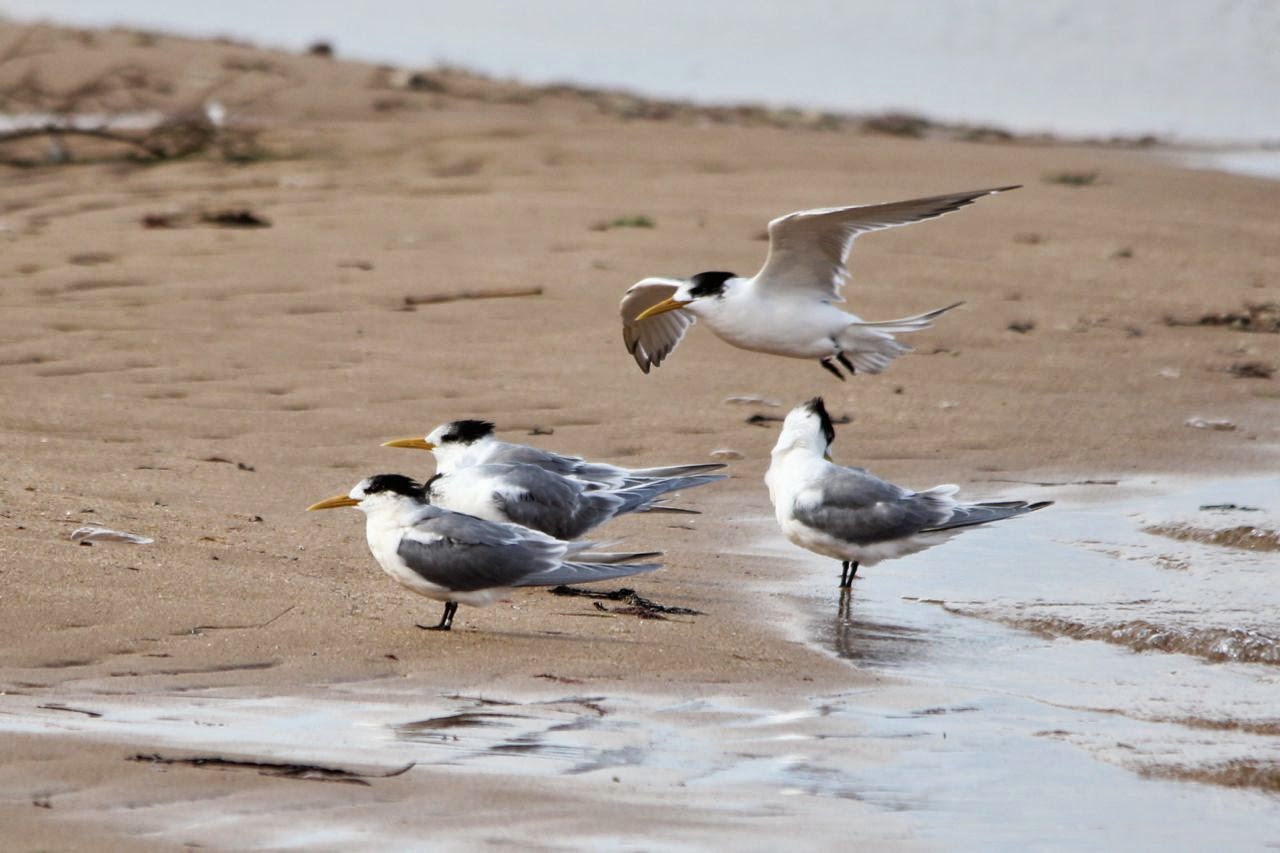
Crested terns

Jeff lacked subtlety at times

The "usual plovers" being Hooded plovers (a nice gathering of four birds) and Red-capped plovers (just a single bird identified) were far outnumbered by the Double-banded visitors.

Having already had an interesting and enjoyable outing I was treated on the walk back to a White-breasted sea eagle fly-by.

Something up ahead!!!
White-bellied sea eagle, Observation Point beach, Phillip Island
When kids get hold of your phone .... I hadn't noticed till too late that my iphone camera was applying filters to today's shots. Thanks Hannah!

Sharing with I'd Rather B Birdin'


Bird on!

Wednesday, March 26, 2014

On the move! Birds of Phillip Island

It's one of those times of year when movement of migratory birds is imminent. Some of our non-breeding visitors are starting to get colour such as some of these Bar-tailed Godwits below. Numbers of Double-banded plover are increasing as they arrive from New Zealand and I have seen my first sightings of Cattle egret for the year.
Bar-tailed godwits, Observation Point, Phillip Island, 22 March 2014. We can play Spot-the-whimbrel!
Landing gear down! More godwits on the move.

Three of the small group of five whimbrel seen at the weekend.
Caspian terns and Pied oysterctachers
"Godwits at front, Pied oystercatchers at the back please and … Smile!"
Now what do we have here - brown, big and fat among the stints & Double-banded plover?
Why it's one of three Curlew sandpiper getting a little breeding colour
Curlew sandpiper, Observation Point, Phillip Island
Arrived at high tide to a different shaped spit than what I was used to - many Black Swan awaited


iPhone view of the main spit attracting the swans, godwits, oystercatchers and terns
Stints, Double-banded plover and the three Curlew sandpiper found a home on a second "mini spit"  (above and below)

I'm not a cat person - greeted by a neighbour's cat on the loose on return from my walk.
Sharing with Wild Bird Wednesday!


Bird on!