Showing posts with label Australian king-parrot. Show all posts

Monday, September 9, 2013

Birdsong from Doongalla in The Dandenongs

You sort-of "had to be there" but I felt immersed in bush and birdsong at the Doongalla section of the Dandenong Ranges earlier last week. The video doesn't really do it justice (you may turn your speakers up a little ....)

What can you hear?


I do remember the first time I heard a Crimson rosella making its "Honky tonk" call. "What was that?" This was the first time I had been able to watch a bird at close range make the call. I was intrigued that such little bill movement was required for such a resonant piping!

Crimson rosella
Laughing kookaburra perching and stretching a wing. Another flew to the ground having spotted something of interest. 

Australian King-parrot
Eastern yellow robin not far from its nest
Not a great shot of a Red-browed treecreeper but I see these infrequently so this was a good day!


You can read more about the history of the Doongalla homestead here (go to page 3 of this pdf file which is a chapter from a local history written by a Richard Coxhill). The house was destroyed by bushfire in 1932 and the property eventually bought by the State Government. I cannot believe that it once looked like this:

Doongalla Homestead c1910 from Richard Coxhill's "History of the Basin" (photo credited to a Fergus Chandler)
Bird on!

Wednesday, May 8, 2013

Birds adding colour to the forest, Tarra Valley

Eastern spinebill, Tarra Valley
This spinebill was a late arrival at a flowering tree that was already playing host to several honeyeater species at the weekend. The location is the steep rainforested valley of the Tarra River in Gippsland. New Holland honeyeater and Crescent honeyeater were also present at this tree (I don't know the name I'm afraid).
New Holland honeyeater (above and below) 

I failed to get a decent picture of a Crescent honeyeater despite it being the bird I was most interested in. I rarely see them! 
Crescent honeyeater (male)
Crescent honeyeater (female)
But let us not get distracted by honeyeaters when there are cockatoos and parrots to be found!
Rosellas, Australian king-parrot, Sulphur-crested and Yellow-tailed black cockatoo were frequently seen.

Yellow-tailed black cockatoo (above & below) 

Sulphur-crested cockatoo
Australian King-parrot (immature or female)
Some Australian icons were commonplace. Kookaburras were easy to photograph - Superb lyrebird not so on this occasion. I saw two female lyrebirds but the extremely dim rainforest light meant that the birds became a brown blur in my photographs. I fondly remember this day in 2011 when a lyrebird explored at arm's length enabling photography and video with short lenses.

Non-feathered Aussie fauna was also seen including wombats, koalas and possums but a chance sighting of a platypus was a highlight.

Laughing kookaburra
Platypus (a distant, cropped view, taken from a bridge over the Tarra River) - a rare opportunity for a photograph of this unique animal.

Sharing with Wild Bird Wednesday


Bird on!

Thursday, January 17, 2013

Wee Jasper birdsong

The air is full of birdsong at Swinging Bridge Reserve, Wee Jasper. "Song" is not always apt when much of the "noise" is coming from the large parrot population. Sulphur-crested cockatoo, King parrots, Crimson rosella and Galah were the most obvious during our visit last week. Yellow-tailed black cockatoo and Gang-gang (although not seen on this occasion) are also regular visitors.


Australian King parrot (male above, immature below)

Immature Crimson rosella
Rufous whistler were actively singing .... err ... whistling! A constant joy!
The penetrating piping of White-throated treecreeper added some further charm.
Yellow-faced honeyeater was the predominant honeyeater species and leant its frequent brisk call to the chorus. 

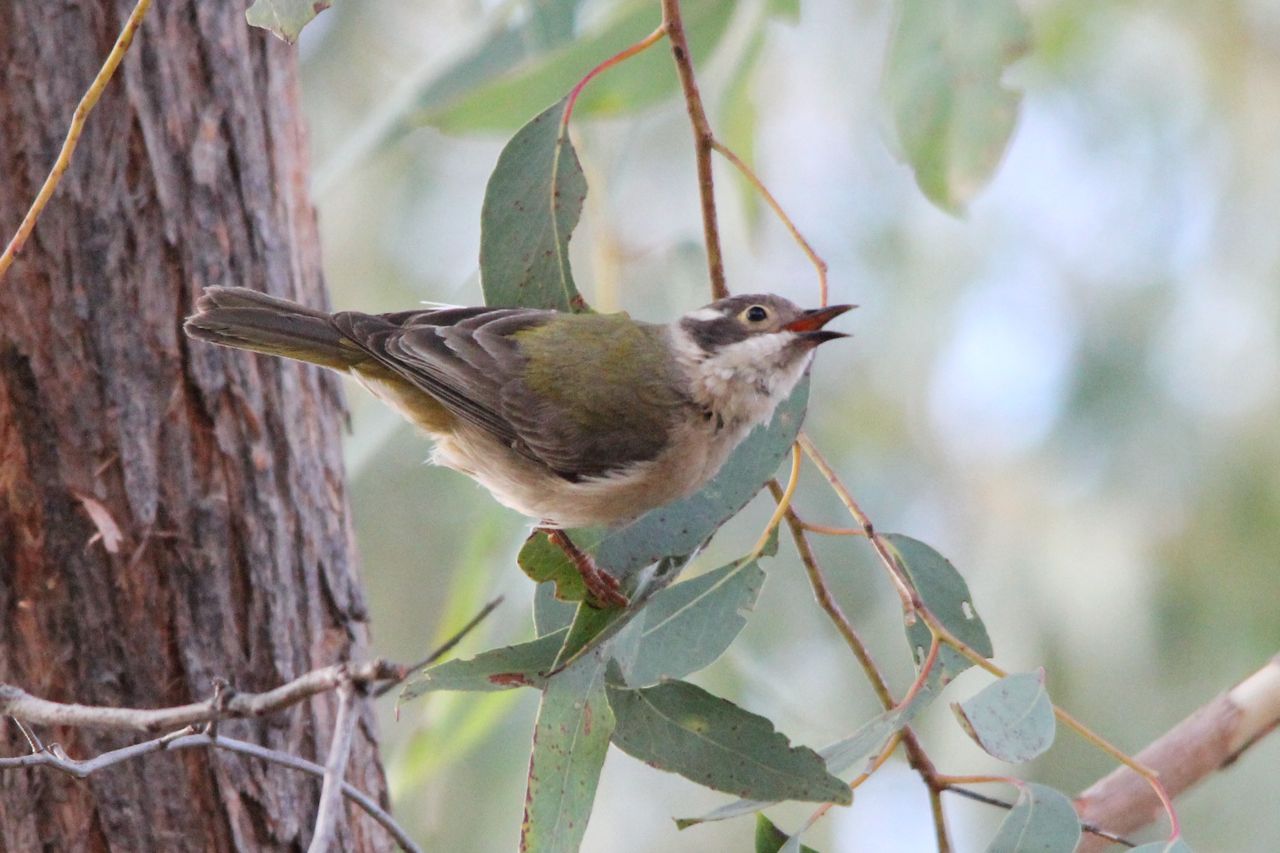
My first thought was that this was an immature Black-chinned honeyeater but it has been pointed out that Brown-headed honeyeater is a much better fit - Excellent - a lifer! A review of Pizzey suggests that there are five honeyeater species with that familiar white nape and paler front. Of these I am yet to see the Strong-billed honeyeater endemic to Tasmania.

The Leaden flycatcher buzzing calls added a different dimension as did the Satin bowerbirds at their bower. Noisy friarbird were ..... well, noisy! Kookaburras provided a daily (or twice daily) chorus. When I first heard roosting Australian wood ducks calling ("gnaaaaw") I wondered if I was listening to a broken kookaburra that couldn't get going!

Australian wood duck - We don't really "quack"

Large numbers of Superb fairywren led the small bird voice accompanied by White-browed scrubwren. Diamond firetail provided an occaisonal finchy flavour.


All in all a most pleasant and amazing soundscape!

Bird on!

Tuesday, April 17, 2012

The thing about car parks

In a recent post I was caught reflecting on birding and car parks!

A birder heading to a new destination opens their car door with much anticipation. Eyes scan the surrounds while ears soak in the sounds. What will reveal itself?

Sometimes a cacophony! The sounds are all around! Where to look? A buzz!

Sometimes, dead silence. Disappointment. Flatness.

I am thinking here of typical birding destinations where a country track delivers one into likely habitat. The "car park" may simply be a rarely visited clearing.

In response to mentioning the car park birding I recently enjoyed at Mouth of Powlett River, I was reminded that:
"...car parks are a very good choice to shoot birds, but that means people have been feeding them of left food of some kind...
With birds it might not be such a problem though, but where wild animals such as baboons in Africa are concerned, they become very dangerous and have to put be eventually put down... a pity!"
Noushka
Thanks Noushka! We all know of such places where birds have become populous as a result of feeding at the car parks of tourist destinations or picnic areas. Noushka is right about such places and as birders, we tend not to frequent them!

I guess that my "great car park birding" sites are really places where simply opening the car door plunges one into a memorable birding experience - no actual car park required! Of course there are many factors contributing including season, time of day and weather.

I now feel an urge to make some lists (I am a birder after all)!

Pete's memorable "car park birding" sites:

  1. Ti-tree car park, Mouth of Powlett River Reserve, Vic
  2. Ben Bennett Bushland Park, Caloundra, Qld
  3. Kamarooka Forest, near Bendigo, Vic
  4. Oswin Roberts Sanctuary, Phillip Island, Vic
  5. Yellingbo Conservation Reserve, Vic

Pete's forgettable "car park birding" sites (big build up, dead silence):

  1. Mortimer Nature Walk, Bunyip State Park, Vic (the birding picked up, there was just not a sound at first)
  2. Chiltern Box-Ironbark National Park, Vic (ditto)
  3. Loch Ard Gorge, Vic (went for Rufous Bristlebird and dipped)

Car parks with bird populations affected by human feeding:

  1. Gloucester Tree, WA (Western rosella, Western ringneck)
  2. Wilsons Promontory, Vic (Crimson rosella)
  3. Sherbrooke Forest, Vic (King parrot, Crimson rosella)
  4. Anywhere there is a chip and a seagull
And of course some pictures:

Supposedly wild Western Ringneck (Barnardius zonarius) at the Gloucester Tree, WA. March 2007. Some bloke driving an electric scooter was selling seed for $2 per back (he didn't look official! I wonder if it is still happening?) 
Yes, the misguided parents of these kids bought a bag! Western rosella (Platycerus icterotis). Gloucester Tree, WA. March 2007
Australian King-parrot (Alisterus scapularis). Sherbrooke Forest car park
The picnic area at Sherbrooke Forest (on a quiet day!)
And now some excellent photos of signs at some of my favourite birding spots!


Friday, January 27, 2012

Other Wee Jasper regulars

Yellow-faced honeyeater was the season's prominent small honeyeater (noisy friarbird representing the larger group) ...


Also enjoyed views of spotted pardalote, treecreepers in their classic poses and rufous whistler. As well as the aforementioned gang-gangs and YTBs there were other parrot companions in king parrot, sulfur crested cockatoo and crimson rosella (not pictured). 

Spotted pardalote


Brown tree-creeper

White-throated tree-crepper

Rufous whistler

Australian King-parrot

Sulfur crested cockatoo

The ubiquitous Superb fairy-wren (female)

This Australian raven was feasting on something
curled up in a leaf.

Willie wagtail

Our lame, constant companion
Practically all birding time was within walking distance of Swinging Bridge Reserve. A drive downstream to Burrinjuck Dam expanded the list (red-rumped parrot, white-bellied sea eagle, white plumed honeyeater, brown tree-creeper, white-faced heron, Australian hobby to name a few).

Surprisingly dipped on nankeen kestrel and white-winged chough (others in the family group saw both!)

The list after 6 days went something like this:

  1. Australian Wood Duck
  2. Pacific Black Duck
  3. Australasian Grebe
  4. Australasian Darter
  5. White-faced Heron
  6. White-bellied Sea-Eagle
  7. Wedge-tailed Eagle
  8. Australian Hobby
  9. Masked Lapwing
  10. Crested Pigeon
  11. Yellow-tailed Black-Cockatoo
  12. Gang-gang Cockatoo
  13. Galah
  14. Sulphur-crested Cockatoo
  15. Crimson Rosella
  16. Eastern Rosella
  17. Red-rumped Parrot
  18. Australian King-Parrot
  19. Laughing Kookaburra
  20. Sacred Kingfisher
  21. Rainbow Bee-eater
  22. Satin Bowerbird
  23. White-throated Treecreeper
  24. Brown Treecreeper
  25. Superb Fairy-wren
  26. Eastern Spinebill
  27. Yellow-faced Honeyeater
  28. White-plumed Honeyeater
  29. New Holland Honeyeater
  30. Spotted Pardalote
  31. White-browed Scrubwren
  32. Yellow-rumped Thornbill
  33. Dusky Woodswallow
  34. Grey Butcherbird
  35. Australian Magpie
  36. Pied Currawong
  37. Black-faced Cuckoo-shrike
  38. Rufous Whistler
  39. Grey Shrike-thrush
  40. Willie Wagtail
  41. Grey Fantail
  42. Magpie-lark
  43. Australian Raven
  44. Eastern Yellow Robin
  45. Welcome Swallow
  46. Common Blackbird
  47. Common Starling
  48. Mistletoebird
  49. European Goldfinch
  50. House Sparrow
  51. Red-browed Finch