Showing posts with label Cape Woolamai. Show all posts

Friday, October 25, 2013

Bird Week Day 7 - Woolamai hoodies

This pair of Hooded plovers is another that I have found myself visiting semi-regularly. I pass them on the beach section of the Cape Woolamai walking trail. They endure considerable traffic living on Woolamai's well-known surf beach (my visits aside)! It is my impression that breeding seasons for these guys are not as successful compared with the "Silverleaves" pair (see My Hoodie Hero!).

Hooded plover, Cape Woolamai, September 2013
I love how this angle of view returns the bird to an egg shape! 


My scene

Well it's the last day of Bird Week 2013. Go and vote for Australia's Favourite Bird. I'll leave the final word to John Clarke!


Bird on!

Tuesday, October 22, 2013

Bird Week Day 4 - Oh my, Woolamai! Birds of Phillip Island

White-fronted chat, Cape Woolamai
A few pictures today from another rewarding early morning walk to Cape Woolamai. When the weather is right it is a place worth getting up early for! It appears that there is always something to different of the feathered kind to see and the views are exceptional!


Good-sized meal for a Chat methinks!
Australasian pipit perched on some Cape Woolamai pink granite
Australian magpie chases down a Brown falcon to provide some feedback

These shots were taken within two seconds. When checking my pictures later the magpie appears to end up with something in it's bill that is not there in the first two shots. I am assuming that the falcon is now short a couple of feathers!

A contemplative Australian magpie. I remembered later that Collingwood had just been knocked out of the AFL finals. 
We surprised each other. One shot and this White-faced heron was off!
On the day of my walk in late September 2013 I took a few snippets of video:


The trail starts from the Woolamai surf beach car park and follows the beach until the cliffs commence. Hooded plover are commonly seen along this stretch (but that's another story). Steps take you to the top of the cliffs and shortly thereafter the trail splits into a circuit. Of late I have tended to take the "western" arm as this follows the ocean enabling me to keep an eye out for distant albatross. Sometimes I return this way as well. The views are spectacular. Taking the other arm will certainly add to your Woolamai day list as it passes through heathland (Superb fairy-wren, cisticola) and a good stand of banksia which is full of honeyeaters (wattlebirds and New Holland Honeyeater dominate).

Throughout the cape there is the opportunity to see raptors (Swamp harrier, Peregrine falcon, Nankeen kestrel, Black-shouldered kite and White-bellied sea eagle).

If the weather is unpleasant (either too warm or too wet and windy) do not take a young family - this is an 8km round trip!

Before your walk you may like to read the Phillip Island Nature Park's Nature Notes for Cape Woolamai.

The kids trudging, January 2011


Early morning view from the beach
I had forewarning of this burn but was relieved to find no evidence of it!
Up on the high ground
Much higher up now looking back towards the beach that was the starting point. Much rain has created fresh water pools on top of the headland.
The destination!
Bird on!

Saturday, July 13, 2013

Cisticola, Fairy-wrens & other Woolamai smalls

If these birds had hung around together a little longer then I may have made a better fist of capturing their moment together. These Golden-headed cisticola and Super fairy-wren shared the same patch of coastal heath when I visited Cape Woolamai recently.

Golden-headed cisticola and Superb fairy-wren, Cape Woolamai
Superb fairy-wren
Superb fairy-wren (female)
Golden-headed cisticola

There are few clues to the correct pronunciation of the name cisticola! It is one of those bird names that has to be heard before an attempt should be made. Sean Dooley does an excellent job in his book "From Anoraks to Zitting Cisticola":
Nothing gives a beginner away more quickly than mispronouncing the names of birds. It shouldn’t matter, but it does, and when I hear an experienced old-timer pronounce ‘plover’ so that it rhymes with ‘clover’ (it should rhyme with ‘lover’), I can’t help but give a misplaced smirk of superiority.
So for the record, if you want to avoid the sniggers of other birders, cisticola should be pronounced ‘sis-tick-er-la’ with the last syllables running together so that it sounds as though you are saying you have tickled your sister, not as if it was the latest flavour of Coke. And certainly try and avoid, as one friend used to say, ‘cisticular’. Particularly with the Zitting before it; people will think you are suffering from a medical condition. 'Sean was a healthy young man until he went to Darwin and picked up Zitting Cisticulars. Now it hurts when he pees.'
In my mind this male Golden-headed cisticola appears distracted by the flight of his love...


A few more Woolamai "smalls"....

Willie wagtail, Cape Woolamai (A "Woolie wagtail" perhaps?)
White-fronted chat
The scene where these shots were taken. Cape Woolamai, Phillip Island. The cape is at the eastern  most point of the island. Here is the view looking west across the rest of the island.
Bird on!

Friday, July 12, 2013

Woolamai honeyeaters

There is a section of the Cape Woolamai circuit that passes through a stand of banksia. Having been observing shorebirds, surf and then coastal heath one is suddenly immersed in the calls and territorial disputes of honeyeaters. The raucous shouts of wattlebirds dominate. Little wattlebird appeared to outnumber Red wattlebird on this occasion.

Little wattlebird, Cape Woolamai

Stand of banksia, Cape Woolamai

Also vying for honeyeater supremacy in this pocket of banksia were New Holland honeyeater and White-plumed honeyeater. A check of my observations reveals that I am yet to see Spiny-cheeked honeyeater in Victoria which is also "commonly" seen here (10% of Eremaea lists ... good enough reason to return in my book).

New-Holland honeyeaters discussing tactics
Moving back into coastal shrubs and heath gives the opportunity to see Singing honeyeater. In my opinion Singing honeyeater has a memorable distribution! Some of my fondest memories have occurred in outback Australia and also along the SW coast of Victoria. Guess where this bird occurs?

I reckon if I'm seeing Singing honeyeater I'm in a good place!

Singing honeyeater, Cape Woolamai, Phillip Island
Seeing this bird recently at Cape Woolamai, Phillip Island marks my most easterly sighting. I'll add this to my list of feel-good places!

Bird on!

Wednesday, July 3, 2013

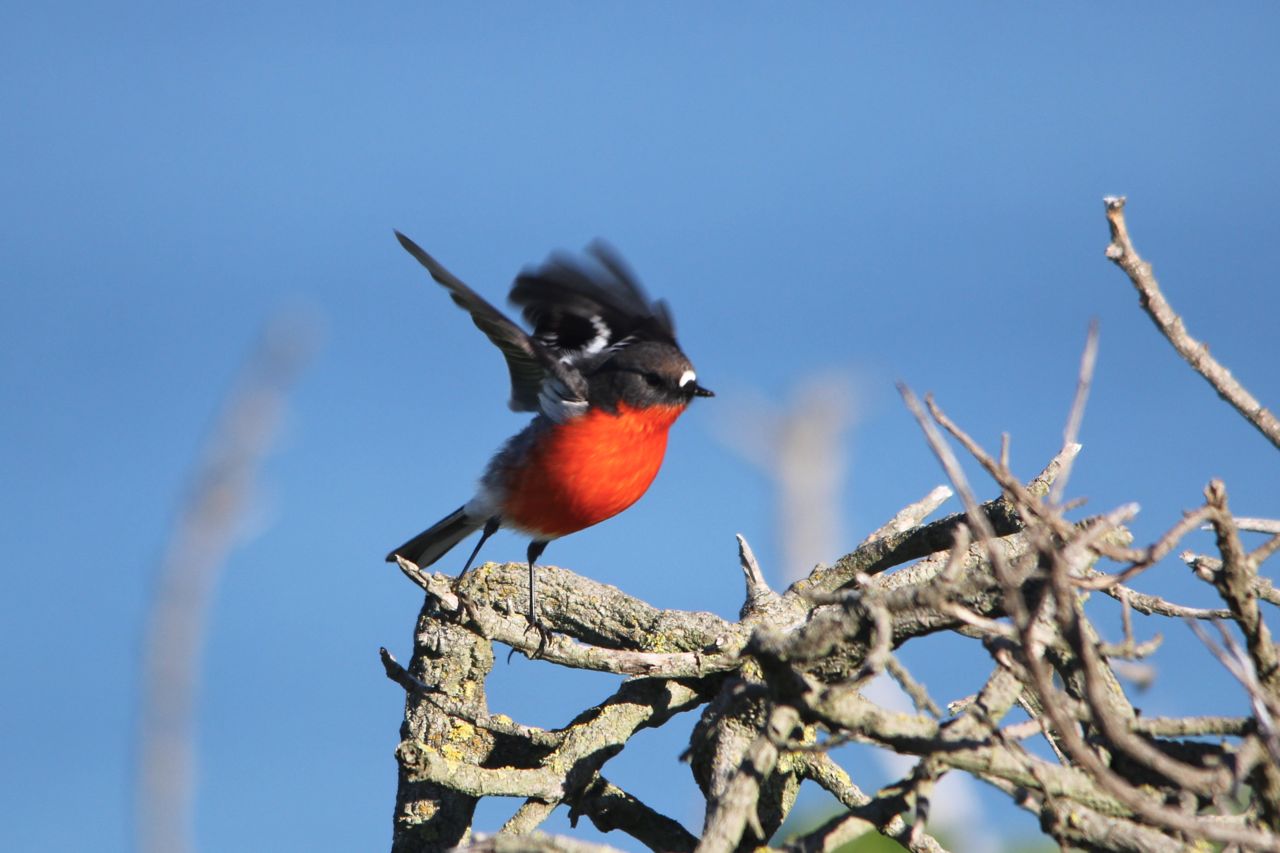
Flame robins enjoying the conditions, Phillip Island

Gorgeous place (on a nice day)! Gorgeous feathery friends!

It's been a while since I've seen Flame robin. Recently at Cape Woolamai I enjoyed walking along the trail with at least one pair keeping just ahead of me.

Flame Robin (AM), Cape Woolamai, Phillip Island, June 2013
I'm outta here!
My first view was a distant snap of the female. Different from the other birds I'd been seeing that morning, I thought: "Now, that has a "robiny" flavour!"

Flame robin, female
 But which one? A splash of colour on the track ahead and an "insurance shot" is taken.


Subsequent views in different positions enabled enough examination of the colouring and pattern of colour to establish that this was Flame robin. We also see Scarlet robin in Victoria which has less orange in the breast that does not extend so far down the belly. The Scarlet robin also has a larger white forehead patch.

Flame robin, Cape Woolamai
When I'm seeing birds in beautiful surrounds I do like to try to capture something of this but find it difficult. The bird shown above appears on the photo below (bottom left).

Spot the robin!
Checking the conditions, Woolamai surf beach
Some White-fronted chat were taking in a similar view and watching the surfers ...


Now play spot the chat!
The old man and the sea!? I was curious to see what would unfold. This is a decent sized wave (in my book)!
Look at him go!
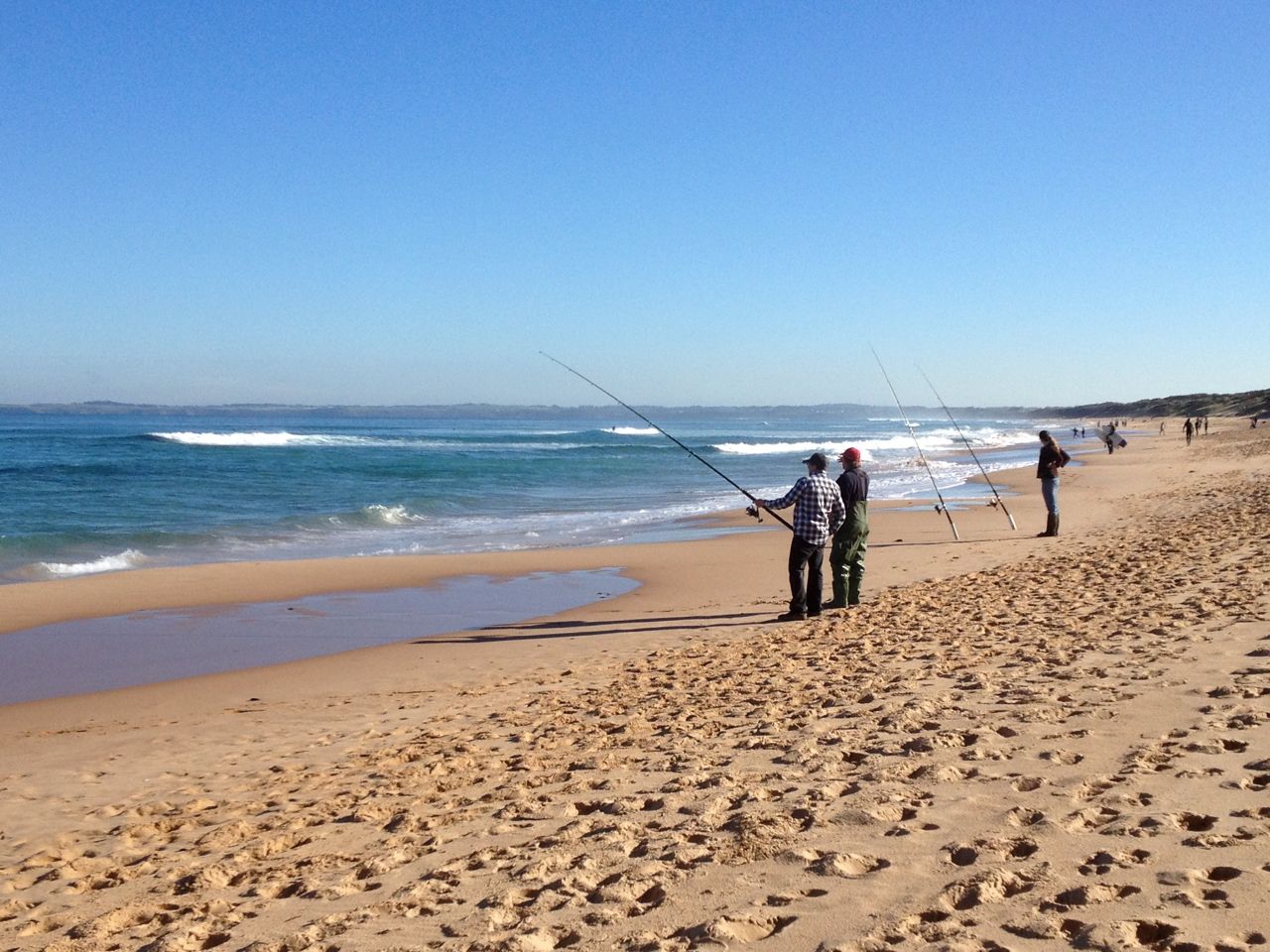
Although I don't think many cameras were pointing at birds, there was no shortage of long lenses!


The gorgeous weather drew many to Woolamai for many different reasons:


The Instagram perspective

And did I mention that in the summer months Cape Woolamai plays host to TENS of THOUSANDS of Short-tailed shearwater? But that's another story!

Sharing with Wild Bird Wednesday


Bird on!