I never connected race day ladies' headwear with egrets until reading one of our esteemed field guides (Pizzey) who refers to the Great egret's breeding plumage:
erectile 'aigrette' plumes cascade down over back to beyond tail tip
One thing led to another (well .... wikipedia) and:
The term aigrette (pronounced: [ɛɡrɛt]; from the French for egret, or lesser white heron) refers to the tufted crest or head-plumes of the egret, used for adorning a woman's headdress.
This knowledge can only add to my sparkling repartee come this year's Victorian Derby Day! Now wouldn't it be great if I had some sparkling aigrette pictures!
If you look carefully you can see a plume.
Great egret - Ardea alba modesta
I mean aigrette
On arrival this egret didn't really choose its perch well
for the breezy conditions ... whoops!
That's better
and now for some dinner
Enlarge me = hint of aigrette
"Aigrettes for human fashion?
Mon Dieu, C'est horrible!"
Hat Inspection Authority in action
The author on race day
By the way, the egret pictures were taken today at the Hull Road Wetlands (on the Olinda Creek near Lilydale).
Point of interest - the egret appears on the reverse of a Brazillian currency 5 reias:
With their comical young & readily accessible habitat these birds are good photographic value. I enjoyed views of a relaxed parent keeping an eye on a skittish youngster at Lilydale Lake recently. February seems to be the month in southern Victoria to see young birds.
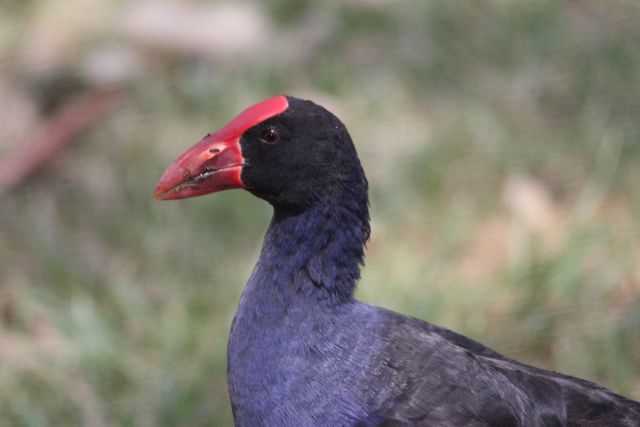
Porphyrio porphyrio melanotus
Lilydale Lake, 3 Feb 2012
Immature bird happily grazing in presence of Mum / Dad (above)
but then felt suddenly spooked.
This goose-stepper was snapped at
Werribee Zoo April 2008
The fellow above and following shots of
swamphen with young are taken at
Karkarook Park, February 2009
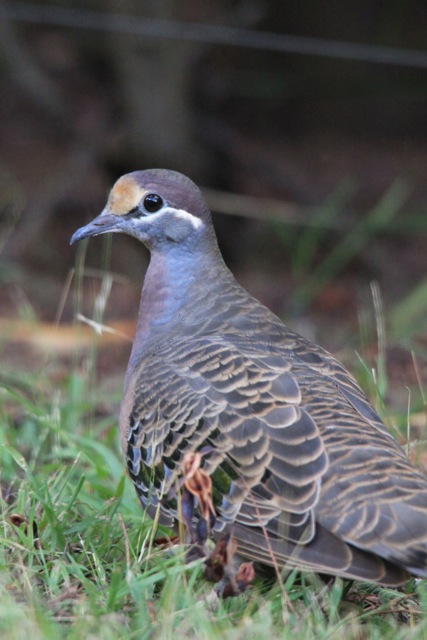
Another close encounter with the generally wary Common bronzewing has led me to read further regarding this bird & bronzewings in general. Here's what I have learned:
Firstly, Pizzey says there are 297 species of pigeon and dove worldwide (Family Columbidae) and Australian has 25 of these (3 introduced - can you name them? I was only familiar with the two).
The genus Phaps contains three species, all Australian
The genus name Phaps does have it's origins in the colour bronze I believe. Apparently there was some jostling about naming rights (a Mr Swainson tried to force his perispera on to Mr Selby's phaps). In a tome called A list of the genera of birds: with their synonyma and an indication of the typical species of each genus by George Robert Gray (1841) there is an appendix: Mr Strickland's commentary (see the relevant paragraph in this Google e-book) which describes this episode.
Other links:
The Phaps chalcoptera page from Birds in Backyards
Wikipedia's Common Bronzewing page which carries this great image of a bronzewing feather. There is also a nice summary of Phaps and related birds here.
Michael Dahlem's Webpage carries some indigenous names for the Common bronzewing and an image of a time when the birds were more plentiful. See it here:
'This photo is a reminder of the "olden days", when Common Bronzewings
were still plentiful - on this occasion we saw a total of about 50 birds'
M Dahlem, Narrabri NSW
Bird painting of a 'Bronze winged Pigeon (Phaps chalcoptera)'
by William Lewis May (1861-1925) Tasmania
Other pages in this blog featuring Common bronzewings can be seen by clicking here, one of which contains a Youtube link to this bit of video taken at Badgers Creek: