Sunday, November 17, 2013

Silverleaves Snipe and Spoonbill Style

Now that we have that necessary bit of alliteration out of the way here's a little update from Silverleaves, Phillip Island.

It's Spring - and it's wet.

The low-lying land is a wetland once again, now deep enough to get Royal spoonbills interested. I counted four there recently and I took the chance to photograph them even though yet another Bass Strait squall was pushing through.

All birds demonstrated bleeding plumage. I read that the males and females look similar
I was pretty happy with some of the angles this bird gave me, showing off its aigrette plumes.
"Oh my! Would you look over there at Reg. What is he thinking? He's been seeing that new stylist"
Rachel couldn't bear to look at him
Quelle horreur!
Here is a Royal spoonbill having an itch in a stiff breeze! 
In other breaking news… The Latham's snipe have returned to Honeysuckle Grove.

I have been driving past this marshy paddock for 26 years. It was not until the 27 November 2011 that the car was brought to a sudden halt one evening (might be dramatising a little, it is a 40kmh road shared with pedestrians) ...

Latham's snipe - such gorgeous markings!


As with the November 2011 experience these photos were taken from the car. On this occasion there must have been at least 20 birds.
Bird on!


Friday, November 15, 2013

The Observation Point beach walk

Every few weeks or so I found myself trudging along the sand heading east from Cowes to Observation Point. The aim is to walk either side of the high tide when waders and other shorebirds are brought closer together.

I remember several still, sunny late afternoons, walking along with the sun at my back looking forward to seeing what birds are roosting or feeding at the end of the spit. Today's post features the walk as I saw it last Sunday morning 10th November.

We start with one of the many bush tracks through to the beach from the streets of East Cowes or Silverleaves. From the eastern end of the residential area it is still 2.5km of beach walking to the Point.
Surrounded by the calls of Grey fantail, Rufous whistler and Grey shrike-thrush
A little way along the beach, the first bird I catch up with is my "Hoodie Hero" Thinornis rubricollis.
This couple were among several groups of Red-capped plover seen 
I caught up with them again on the way back - with the sun out! Red-capped plover Charadrius ruficapillus
iPhoto geotags - the blog post is tracking from left to right!  This next photo of the beach is taken at the "2nd-from-left" stickpin & looking back west (from where I have come)!
Every few months the shoreline changes. I love the tidal lagoons we have at the moment - they make for great toddler pools! This is a good two hours after high tide (note the high tide level is marked by seaweed and also the tracks from the Nature Park staff quad bike - out to check their feral cat traps)
Observation Point and this section of beach are designated part of the Phillip Island Nature Reserve. As one approaches the spit there is signage indicating its importance as a refuge for migratory waders. It is important to not disturb the birds and good views can be obtained with binoculars and long lenses without a single bird taking flight. Well before the spit care must be taken during the beach walk as local shorebirds may be nesting above the tide line.

Pied oystercatcher - now we are at the end of the spit looking in towards the Rhyll Inlet
Caspian tern (and Pacific gull)
Pacific gull
iPhone shot of the end of the spit (the black dots are the group of godwits shown below)

Incoming! Red-necked stint join the Bar-tailed godwits
"OK fellas, I think we got this lot all rounded up!" Red-necked stints appear to be herding Bar-tailed godwits, Observation Point, Phillip Island
Bird on!

Wednesday, November 13, 2013

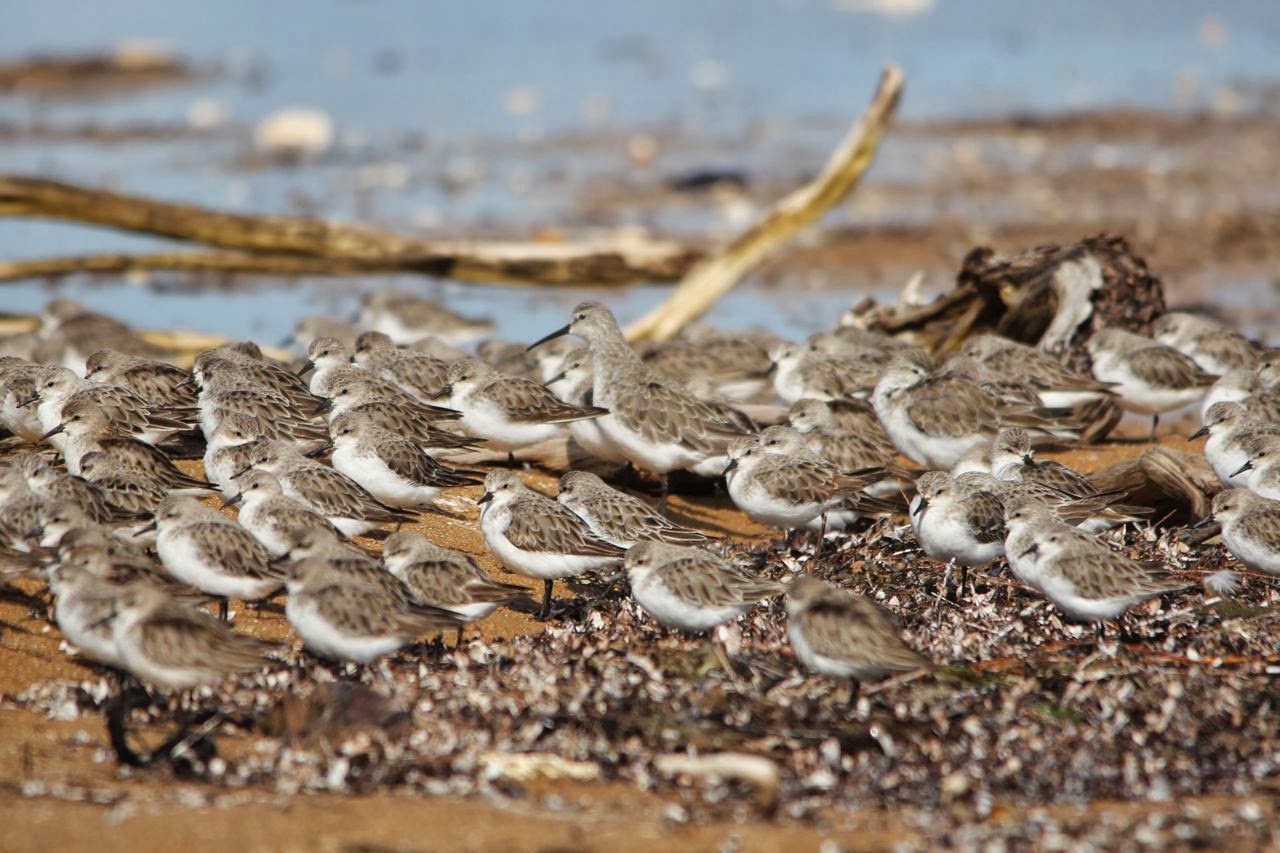
Red-necked stints harbouring sandpipers

These amazing small migratory waders are climbing very quickly up my favourite species list! I had cause to find out more about Red-necked stint Calidris ruficollis after spending some time with a group at Observation Point, Phillip Island last weekend.

"You know what Reg? I'm beginning to think that he can still see us even when we do hide our heads under our wings!"
Red-necked stint Calidris ruficollis "winter plumage"
It titillates me to think that these little guys endure the extremes of Siberia and Alaska (albeit in the northern summer) only to form sheltering rafts behind driftwood on a balmy Spring morning in Victoria, Australia. OK so it was only about 11'C but the sun was shining and there was only a zephyr of a breeze!


Red-necked stint. There was a group behind every bit of driftwood. Caspian tern and Pied oystercatcher can be seen in the distance.
While I was photographing this group one bird stuck its head up for a better view…
A stint on steroids? or Curlew sandpiper Calidris ferruginea
Looking at my photos later on I noticed a second sandpiper to the right of the first bird noticed.
Lots more information about these little travellers at:

Sharing with Wild Bird Wednesday

Bird on!